
Government agencies typically hold the data an investigation needs. The challenge is often bringing it together. When claims, payments, company records, contracts, and compliance histories all sit in different systems, the relationships between them are hard to see.
This can play out in claims from providers that appear unrelated, suppliers whose common ownership is hidden, or money moving through a chain of companies, properties, and professional intermediaries.
In each case, teams need to understand what’s connected, what those connections mean, and whether the evidence justifies intervention, further investigation, or no action.
The same challenge appears across anti-money laundering and counter-terrorism financing, multi-agency efforts to protect government payment programs, and scrutiny of procurement and grants. Investigators have to connect government records with data held by providers, contractors, and regulated businesses.
The investigation gap is the time between when information becomes available and when its significance becomes clear.
When that gap is narrow, agencies identify risks earlier and make decisions with a clearer view of the evidence. When it widens, connections are found too late, or not at all. Every hour spent reconciling systems is an hour not spent assessing risk or acting on it.
Why does the investigation gap exist?
Case management platforms, payment systems, company registries, procurement records, compliance databases, and service records each hold their own piece of the picture. But they were not designed to show how those pieces connect.
Each system does its own job well enough. The problem is seeing how a new claim, payment, company, or relationship changes what the organisation already knows.
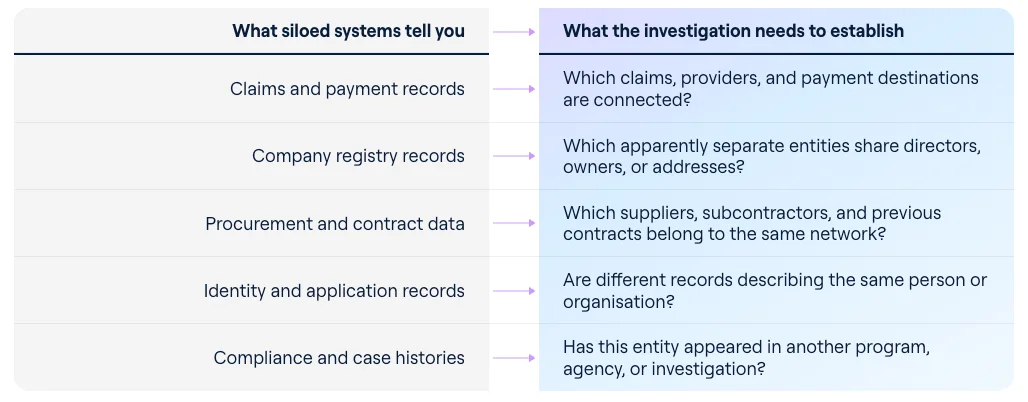
By the time staff have manually searched for and reconciled those records, the opportunity to act may already have passed.
Closing that gap needs a connected approach: one that connects information across systems rather than asking teams to piece it together themselves.
Building a connected picture
Traditional systems organise records. Graph technology also captures the relationships between them, so a person, company, claim, or transaction can be understood as part of one evolving intelligence picture rather than an isolated entry.
As new information arrives, it becomes part of the same connected model. Teams don’t have to rebuild the network each time a fresh detail surfaces.
The judgement calls still belong to people. A system can flag that two records may describe the same entity, or that a pattern warrants examination, but a human decides what it means and what action, if any, it justifies.
Read also: Australian agencies need an AI challenge log before automation scales
This means teams spend less time manually cross-referencing systems and more time assessing the evidence behind their decisions.
Following the connections
Consider a program integrity team reviewing claims submitted by two providers that appear unrelated: different business names, services, and recipients.
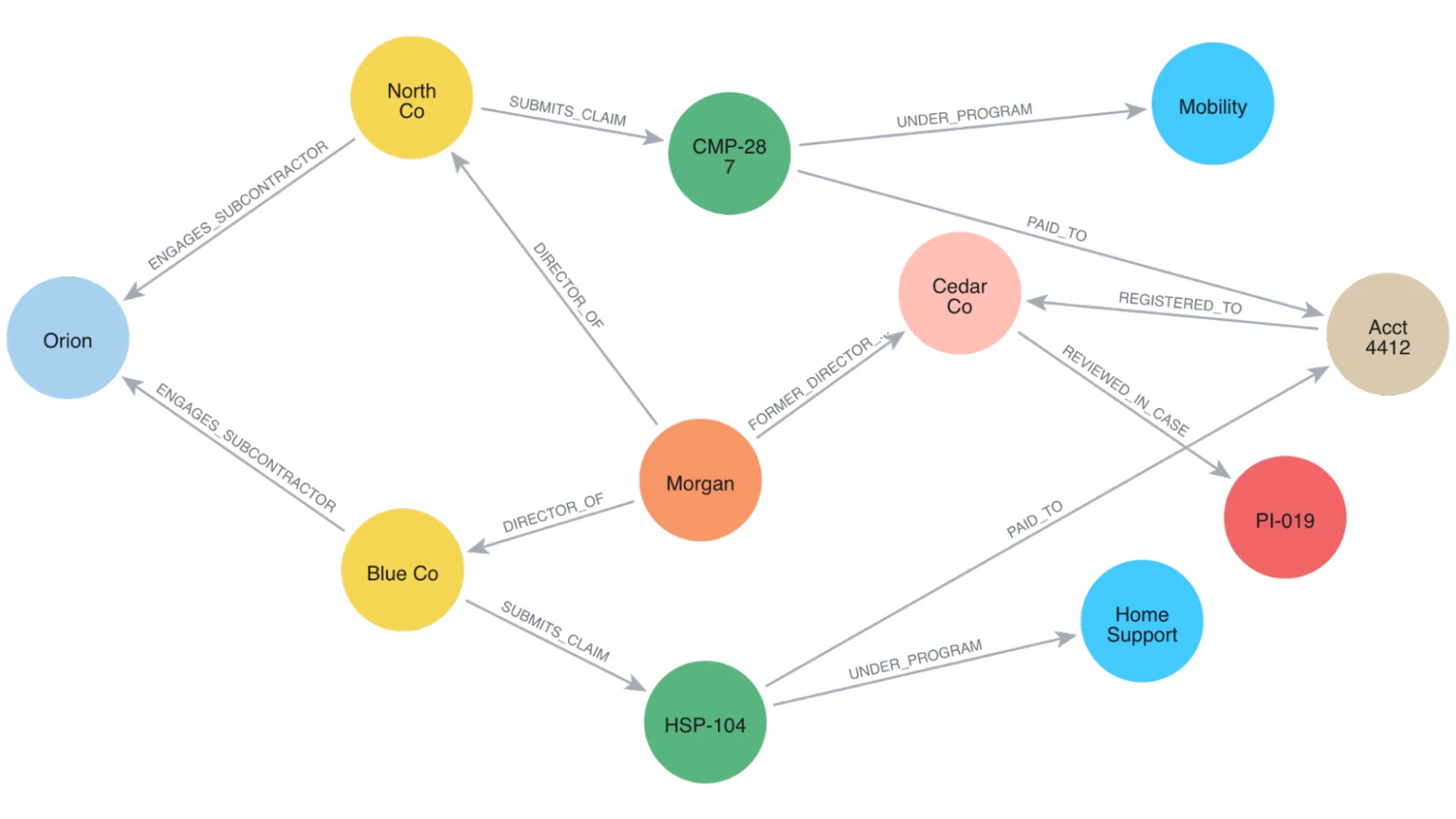
When the team connects the records, they find that the two providers share a director. That person was formerly a director of a company reviewed in an earlier program integrity case, and payments for both claims are going to an account registered to that same flagged company. Both providers also engage the same subcontractor across different government programs.
These connections establish a line of inquiry without proving any wrongdoing.
The team can follow the links from a claim to a provider, the people behind it, related companies, payments, and previous compliance activity instead of searching each system in turn.
AI needs the same connected picture
As agencies bring AI into this work, fragmented data creates more risk.
AI can help analysts navigate complex information and surface connections faster, but it shares the same limitation as anyone working from an incomplete picture: it can only work with what’s in the system.
If relevant records and relationships remain split across systems, AI may produce plausible answers based on only part of the evidence.
A graph-powered approach changes that, letting AI trace its reasoning back through those connections to the organisation’s own data, rather than filling in the blanks itself.
AI doesn’t change who is accountable for the decision. A system can flag a connection worth investigating, but a human must decide whether to act. If the evidence behind a finding cannot be traced back to its source, the resulting decision becomes much harder to defend.
Closing the investigation gap
An organisation closes the investigation gap when it can connect new information to what it already knows, assess the evidence, and decide while there is still time to act.
It must also be able to explain that decision and trace the records that support it.
That’s the practical value of connected data: timely decisions, with a clear path back to the evidence behind them.
Explore GraphAware Hume and see connected intelligence in action →

Luanne Misquitta
Luanne Misquitta leads Neo4j's global public sector practice. With more than 18 years' experience delivering graph technology in production, and as co-author of Neo4j: The Definitive Guide (O'Reilly), she advises government organisations on applying connected intelligence to mission-critical operations.
 Latest
 Popular